For forty-four years and nine Olympiads, Israel had sent athletes to the Games and watched them come home empty-handed. Not for lack of trying, and not for lack of pain — Munich 1972 had turned an Olympic delegation into a massacre. So when the draw for the women's 61kg judo half-middleweight class was posted at Barcelona's Palau Blaugrana on 30 July 1992, one Israeli name carried a weight that had nothing to do with her weight class.
Yael Arad, born and raised in Tel Aviv, had spent close to two decades on the tatami by the time she reached Barcelona. She arrived as a genuine contender, ranked among the best in the world in her division, and she fought like one. Bout by bout, she worked her way toward the medal rounds in front of a crowd that had no particular reason to know her name yet.
The contest that made the difference came before the final. Arad drew Germany's Frauke Eickhoff, the reigning world champion in the division and, to that point, unbeaten on the biggest stages. It was the kind of match where the winner alone was guaranteed a medal — and Arad won it, sending Eickhoff out of medal contention and putting herself one victory away from gold.
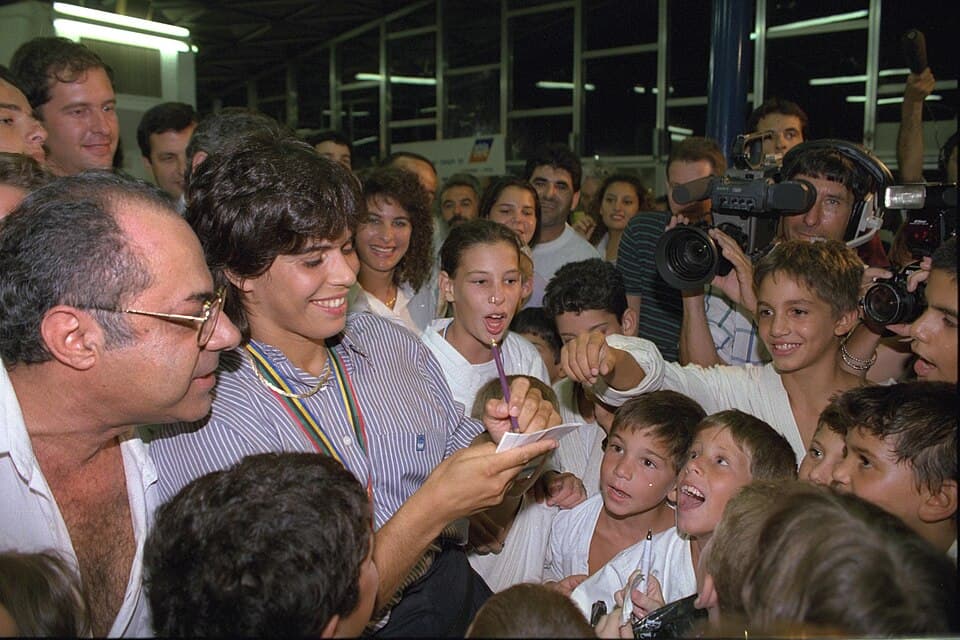
That last victory never came. In the final, Arad met France's Cathérine Fleury in a bout so tight that neither judoka could force a scoring decision the crowd would remember by technique alone; it went to the judges, and the flags went up for the Frenchwoman. Fleury took gold. Arad took silver — and, in doing so, became the first Israeli in history to stand on an Olympic podium.
It is easy, decades on, to flatten a historic first into a single triumphant headline. What made the moment resonate in Israel was not just the medal itself but the way Arad framed it. She dedicated the silver to the eleven Israeli athletes and coaches murdered by Palestinian terrorists at the 1972 Munich Olympics — closing, in one gesture, a loop of grief and vindication that Israeli sport had carried since the moment it happened.
"That day I changed from a person who wanted to a person who could," Arad would later say of the final. The line has outlived the specifics of the bout itself, because it captured something true about what the medal meant beyond judo: proof, finally, that Israeli athletes could stand at the very top of an Olympic competition and not just take part in one.
The country did not have long to savor a single medal. One day after Arad's silver, fellow judoka Oren Smadja — competing in the men's under-71kg category — won bronze, giving Israel two Olympic medals from the same Games, in the same sport, on consecutive days. What had been a 44-year drought became, almost overnight, the foundation of judo's outsized place in Israel's Olympic story.
Arad herself stayed close to the sport long after Barcelona. She went on to coach Israel's judo team at the Sydney 2000 Olympics, passing on to the next generation what she had learned in the arena where it had mattered most: that the wait for a first Israeli Olympic medal ended not with a gold, but with a silver that felt, to everyone watching, like gold.