On 19 July 1952 — seventy-four years ago today — the Games of the XV Olympiad opened at the Helsinki Olympic Stadium. Finland's president, Juho Kusti Paasikivi, declared the Games open. Paavo Nurmi, the country's greatest distance runner, carried the torch into the arena and lit the flame, before fellow running legend Hannes Kolehmainen kindled a second fire at the top of the stadium tower.
Sixty-nine nations and 4,932 athletes had gathered. Somewhere in that long parade of teams marched a small column of athletes behind a blue-and-white flag that had never before been carried into an Olympic stadium: Israel, competing at the Games for the very first time.
The debut was about far more than sport. The state was barely four years old, born amid the 1948 war that had kept any Israeli team away from the London Games that summer. Olympic historians record the essential point plainly: Israel competed at its first Olympics in 1952 in Helsinki, the same year in which its National Olympic Committee was formally recognised by the International Olympic Committee.
That sequence matters. In the early 1950s, membership of the Olympic family was one of the clearest certificates of normal statehood available to a new country — a stage on which Israel could appear not as a contested political question but as simply one delegation among sixty-nine. Marching in Helsinki was, in its way, a second declaration of independence.
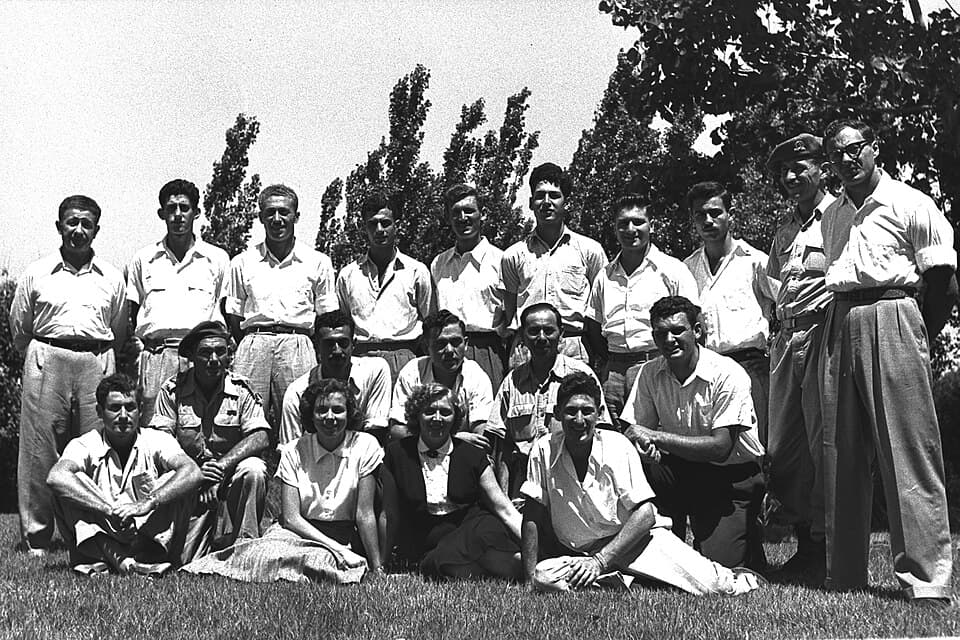
The delegation itself was modest and eclectic: twenty-five athletes — twenty-two men and three women — entered in seventeen events across five sports: athletics, basketball, diving, shooting and swimming. The honour of carrying the flag at the opening ceremony fell to Abraham Shneior, the 23-year-old captain of the national basketball team. Born in Mandatory Palestine and captain of Maccabi Tel Aviv, Shneior embodied the generation for whom the state and its sporting institutions had grown up together.
On the field of play, the results were what one would expect of a tiny, war-scarred country facing the world's best. The basketball team lost its qualification-round matches, falling 47–57 to the Philippines and then, agonisingly, 52–54 to Greece — a two-point margin that separated the debutants from the main tournament — to finish joint twentieth. On the track, sprinter David Tabak battled through to the second-round heats of both the 100 metres and the 200 metres before bowing out.
The man who came closest to the podium was a diver. Yoav Ra'anan, then twenty-four, finished ninth on the three-metre springboard — one place outside the leading group — and twenty-fourth on the platform. His Helsinki showing was no fluke: two years later he won springboard gold and platform silver at the 1954 Asian Games, and he returned to dive for Israel at Melbourne in 1956.
In a delegation of pioneers, Ra'anan was the first Israeli Olympian who could genuinely be discussed in the language of contention rather than mere participation.
The timing gave the debut an added resonance. Helsinki 1952 was the first cold-war Olympics: the Soviet Union, too, was competing at its first Games, and the stadium became a stage on which the new post-war order presented itself to the world. Israel entered the family of Olympic nations at the precise moment that family was being redrawn — and for a state whose very legitimacy was still contested in international forums, the value of being an ordinary name on an extraordinary list is hard to overstate.
No medals came home from Finland, and none would come for another four decades, until Barcelona in 1992. Yet Helsinki endures as one of the most consequential entries in the history of Israeli sport. Every Israeli Olympian since — every judoka, sailor, gymnast and runner who has stood on a podium or simply marched at an opening ceremony — traces a direct line back to that column of twenty-five who walked into the Helsinki rain-grey afternoon of 19 July 1952 and, by walking, made a point no communiqué could: the state was here, and it intended to compete.