Žalgiris Kaunas have signed Jonas Valančiūnas, bringing Lithuania's senior centre back to domestic club basketball after 14 NBA seasons. The move gives the EuroLeague side one of the continent's most recognisable interior players. Its real value, though, is more specific than reputation: a half-court reference who can create efficient possessions without the offence needing to be built around perimeter isolation.
The homecoming label carries an edge. Valančiūnas developed with Perlas and Lietuvos Rytas before leaving for Toronto in 2012, and he has never returned to his former club. His last EuroLeague season came with Rytas in 2010/11, followed by a EuroCup campaign in which he averaged 10.8 points, 7.6 rebounds and 1.6 blocks. Wearing Žalgiris green reconnects him with Lithuanian basketball while placing him on the opposite side of its most charged domestic rivalry.
Toronto took Valančiūnas fifth in the 2011 draft, and his NBA career then ran through Memphis, New Orleans, Washington, Sacramento and Denver. Across that six-team span he moved from long-term starter to situational veteran without losing the core of his game — scoring on the block, screening for higher-usage creators, controlling the defensive glass and accepting changing minutes as lineups grew smaller and faster.
His final season in Denver captures that last transition. Valančiūnas appeared in 65 games, started six, and averaged 8.7 points, 5.1 rebounds and 1.2 assists in 13.4 minutes behind Nikola Jokić. The modest playing time should not be mistaken for an empty role; Denver needed concentrated physical production in short stretches. Žalgiris can now offer the same skills more possessions and a clearer place in the hierarchy.
Offensively, the appeal starts with geometry. A centre who establishes deep position forces the defence to choose between conceding single coverage and sending help from a shooter, and his screens can create separation before he even touches the ball. Offensive rebounds turn defended possessions into second chances. For those advantages to hold up at EuroLeague speed, Žalgiris will need to keep enough shooting on the floor around him that the lane doesn't clog with extra defenders.
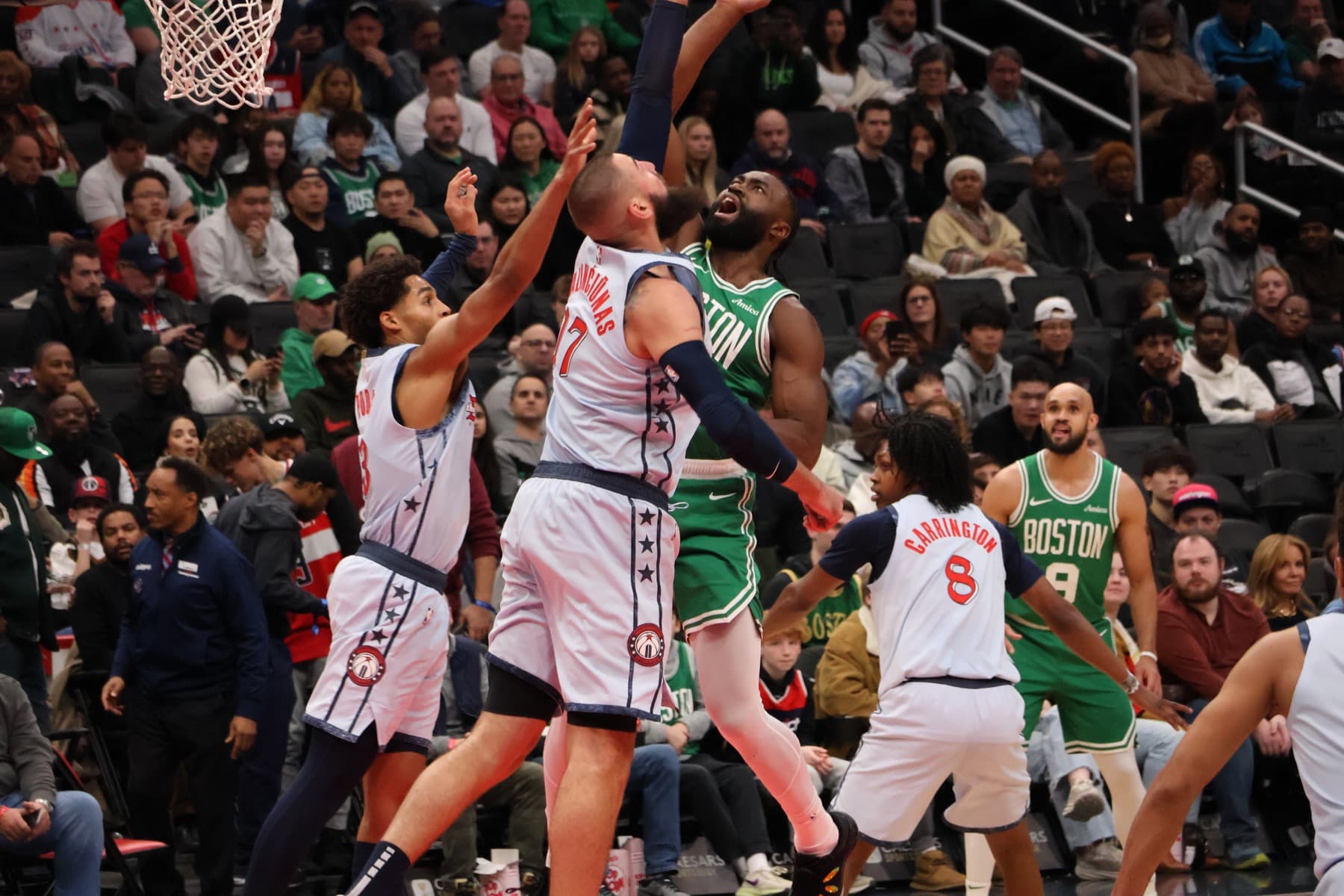
The defensive calculation is less forgiving. Valančiūnas remains a strong rebounder and a deterrent near the rim, but opponents will look to involve him repeatedly in pick-and-roll actions and drag him into space. Žalgiris can guard against that with conservative coverage, disciplined weak-side rotations and mobile defenders elsewhere on the floor. The signing supplies size; preventing rivals from turning that size into a target is the coaching challenge that follows.
His recent international form suggests meaningful high-level production is still there for the taking. At EuroBasket 2025 he averaged 15.7 points and 6.7 rebounds for Lithuania across seven games, converting 64.7 per cent of his two-point attempts. A national-team tournament is shorter than a EuroLeague season, but it showed that a larger offensive workload can still produce efficient scoring rather than ceremonial veteran minutes.
Žalgiris are, in effect, making two bets at once. The emotional one is that Lithuania's most established active centre can deepen the bond between the team and its basketball public. The competitive one is that a defined European role will get more out of Valančiūnas than the reduced assignment he held in Denver. Neither is guaranteed by the name on the shirt, but both rest on a skill set — screening, post scoring, rebounding — that remains immediately legible.