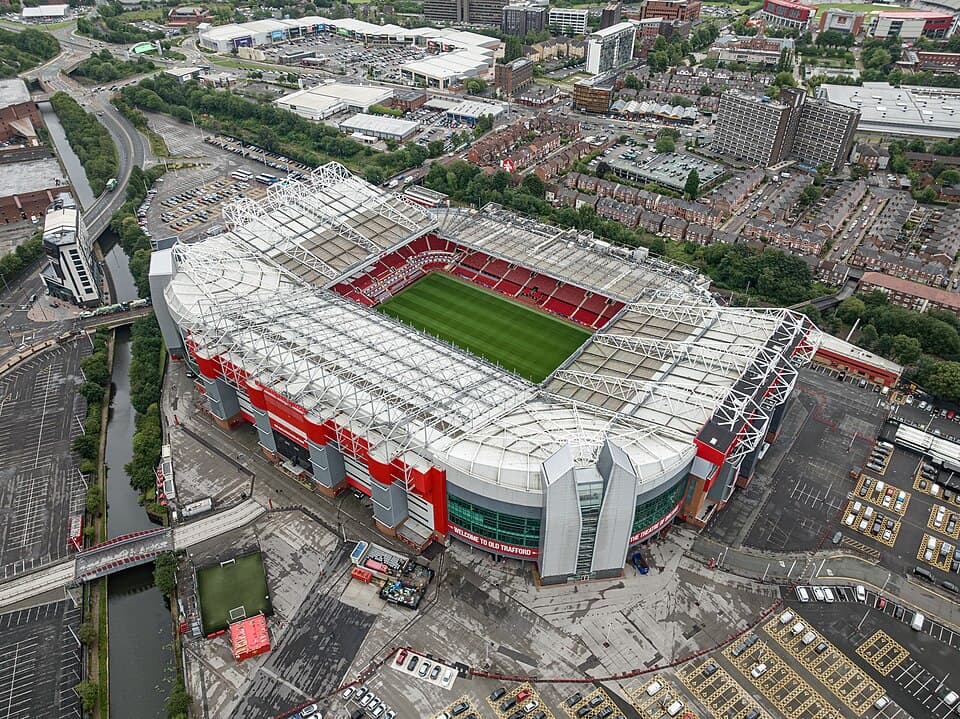
Manchester United's ambitions for a new home have crystallised into something startling in scale: a 100,000-seat stadium, initially costed at around £2 billion, that would be the largest in Britain and would sit almost within touching distance of the ground it replaces.
ONE reports that the new arena is planned for a site roughly 350 metres from the current Old Trafford, on industrial land at what the club calls the Trafford Wharfside district — ground that, according to the report, previously hosted a go-kart track. Independent reporting places the plot between John Gilbert Way, Wharfside Way and Europa Way, just north-west of the existing stadium.
The design brief has already shifted once in public. Foster + Partners, the architecture practice United appointed for the project, first unveiled a dramatic canopy-topped concept; more recent images have shown a more conventional bowl-shaped ground, though the club has stressed those renderings are not final either.
Collette Roche, chief executive of the stadium development company, framed the latest step — publication of the Wharfside Masterplan — as "another significant milestone in our journey to create a new world-class home for Manchester United at the heart of a vibrant and transformational district for Trafford and Greater Manchester."
The project is not just a football venue. United and their development partners are pitching a full district around it: a tree-lined boulevard styled on Wembley's approach for matchday crowds, waterfront bars and restaurants, a rebuilt tram station, and residential towers overlooking the Manchester Ship Canal. Separate reporting puts the wider scheme at 15,000 new homes and 48,000 local jobs, with the club claiming it could generate £7.3 billion a year for the UK economy.
None of that comes cheap, and the financing question hangs over the entire venture. United's own accounts show total debt approaching £1.3 billion, a legacy largely traced to the Glazer family's leveraged 2004 takeover, and the club is currently paying upwards of £30 million a season in interest alone. United's leadership insists the new stadium will ultimately pay for itself through higher matchday and commercial revenue, funnelling extra income back into the playing squad, but analysts have flagged that lenders may push the Glazers and co-owner Sir Jim Ratcliffe to put up more of their own capital than first envisaged.
Ratcliffe, the INEOS billionaire who took a controlling stake in football operations in 2024, has been the driving force pushing the timeline forward. The stated goal is a "spade in the ground" by the end of 2026, with the stadium targeted for completion in time for the 2030-31 season.
Fan groups are watching the process closely, and not uncritically. Duncan Drasdo, chief executive of the Manchester United Supporters' Trust, has said the priority is to avoid the pitfalls other clubs have hit when leaving historic homes: "We want to make sure we end up with an atmospheric stadium, not a soulless bowl, as we've seen with other clubs when they've moved to a new ground."
What happens to the old Old Trafford remains an open question. ONE reports that its fate — full demolition, partial preservation, or conversion into housing — has not been formally decided, and will likely be settled only once the new stadium plans are locked in.
According to the report, detailed designs are expected to be ready by late 2026 or early 2027, after which they would go to formal submission with planning committees. A public consultation with fans, residents and local businesses is due to begin shortly, a step that will shape everything from the boulevard's design to how the club manages the disruption of building a stadium of this size a few hundred metres from a live, matchday-operating ground.
For a club that has spent much of the past decade playing catch-up off the pitch as well as on it, the stadium has become the clearest marker of how Ratcliffe's ownership wants United to be judged — not just by trophies, but by whether it can deliver Britain's biggest football ground without the debt burden swallowing the project whole.