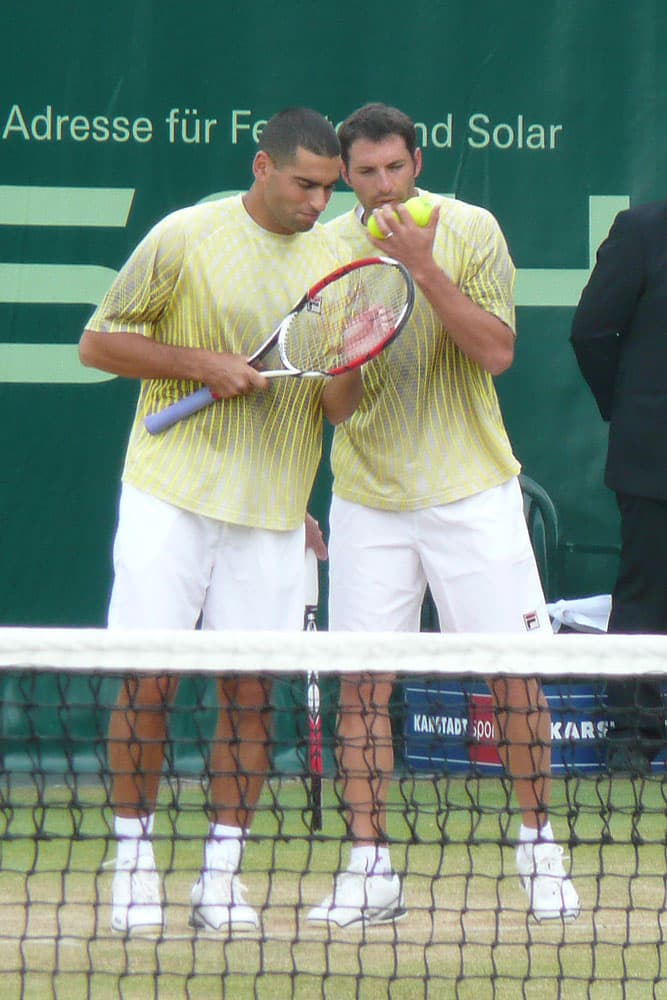
Rod Laver Arena empties out fast once the marquee singles matches finish, but on the evening of Saturday, 26 January 2008, a knot of Israeli flags stayed pressed against the railings. Down on court, two players who had spent a decade grinding through Challenger towns and Tuesday-afternoon doubles slots were serving out the biggest match of their careers. When Jonathan Erlich's final backhand volley dropped away from Arnaud Clément, he and Andy Ram had won 7–5, 7–6(4) — and Israel, for the first time, had a Grand Slam champion built entirely at home.
It sounds like a modest thing to call the men's doubles final a country's defining tennis moment, but for Israel it was exactly that. Ram had already won two Grand Slam mixed-doubles titles, at Wimbledon in 2006 with Vera Zvonareva and at the French Open in 2007 with Nathalie Dechy — proof he belonged at the top of the sport. What Melbourne gave Israel that Erlich's and Ram's other titles could not was a trophy shared by two Israelis, won as an Israeli team, under an Israeli flag raised twice.
Both men had arrived in Israel as small children of Latin American immigrant families. Erlich was born in Buenos Aires in April 1977 and moved with his parents to Haifa before his first birthday. Ram was born in Montevideo, Uruguay, in April 1980, and his family settled in Jerusalem when he was five, which is where he first picked up a racket. Years later the two met through Israel's Wingate Institute tennis program and began partnering on tour, eventually becoming so inseparable in Israeli sports pages that they were simply known as "Andyoni."
Their breakthrough had come five years earlier, at Wimbledon in 2003, where Erlich and Ram reached the men's doubles semifinals — the first time any Israeli had gone that deep into a Grand Slam draw in any discipline. It cost them nothing in ambition; if anything it convinced them doubles was where they could win majors, even if the majors themselves stayed just out of reach for years afterward.
Melbourne in January 2008 finally delivered it. Seeded eighth, Erlich and Ram opened the tournament with an unusual first-round assignment: an all-Israeli derby against Dudi Sela and Harel Levy, which they won in straight sets. They then beat Scott Lipsky and David Martin, outlasted the Czech pairing of František Čermák and Lukáš Dlouhý, and downed Marc Gicquel and Fabrice Santoro in the semifinal to reach a final against the seventh-seeded French duo of Clément and Llodra — themselves former Davis Cup stalwarts and no easy final-round obstacle.
The final swung on small margins. Erlich and Ram took the first set 7–5, then had to survive a tighter second set that went to a tiebreak, closing it out 7–4 to seal the match 7–5, 7–6(4). It was, as Israeli and international press noted at the time, the first Grand Slam trophy ever won by an all-Israeli doubles team — a distinction that, for all of Israel's individual Grand Slam success in mixed and singles play since, still stands.
The Melbourne title also marked the peak of Erlich and Ram individually: in July 2008, only months after the final, both men reached a career-high doubles ranking of world No. 5, the highest either would ever attain.
Their partnership kept paying off for Israeli tennis well beyond Melbourne. In September 2009, Erlich and Ram won the decisive doubles rubber as Israel stunned Russia 3–0 in a Davis Cup World Group quarterfinal in Tel Aviv, beating Marat Safin and Igor Kunitsyn in five sets after Harel Levy and Dudi Sela had already won both opening singles. It sent Israel into its first and, to date, only Davis Cup World Group semifinal.
Erlich played on tour until 2022, closing out a career built almost entirely on doubles craft rather than singles firepower; Ram retired in 2014. Between them they turned a nickname into a genuine Israeli sporting institution. But it is the Melbourne afternoon in January 2008 that remains the reference point — the moment two sons of immigrant families, raised on Israeli hard courts, put an Israeli team's name on a Grand Slam trophy for the only time in the country's history.