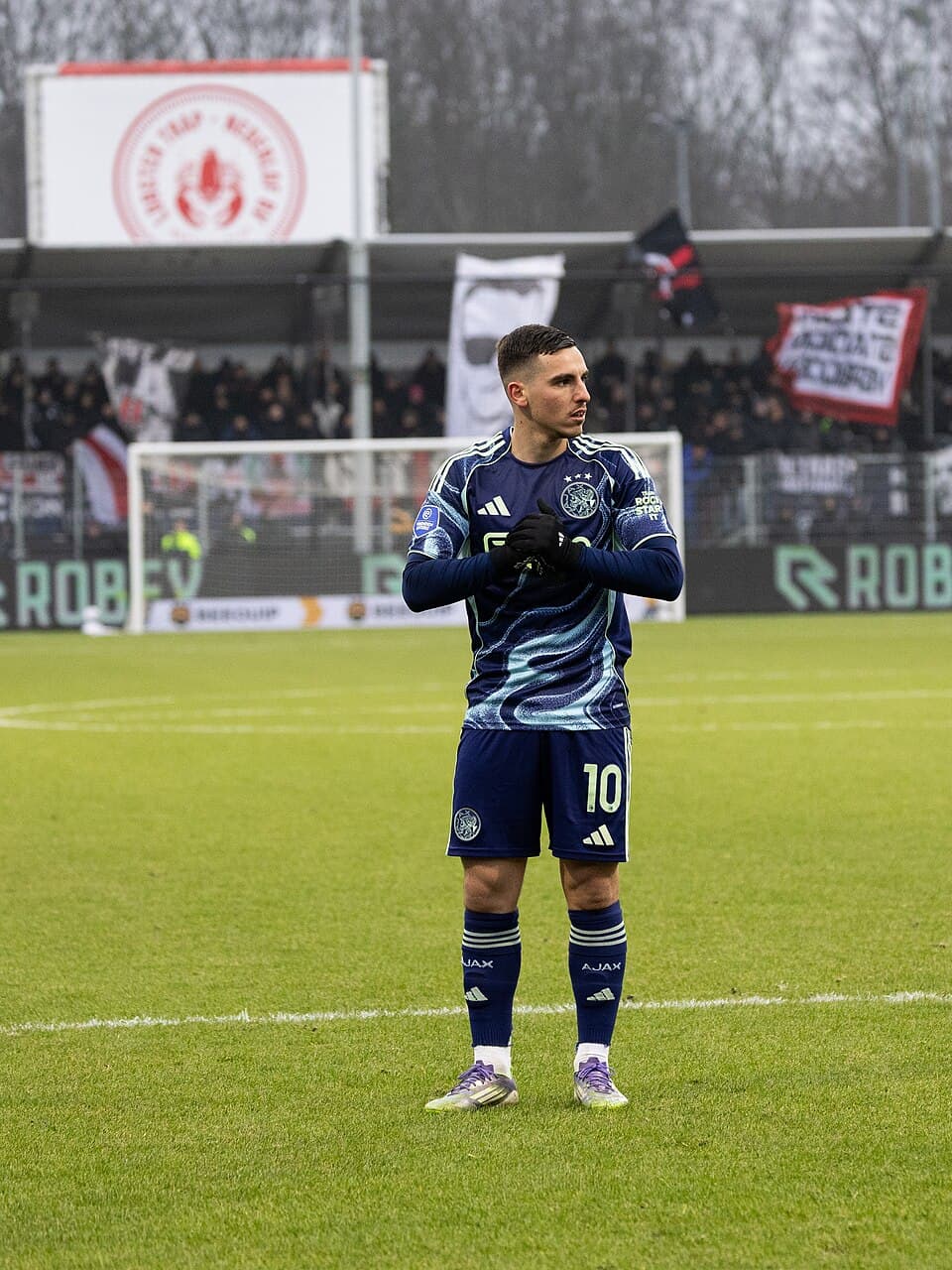
Oscar Gloukh has chosen continuity over another summer transfer chase. The Israel midfielder says he remains focused on Ajax unless the club decides otherwise, and he has defined his second-season objective with unusual clarity: become a regular starter. It is a more demanding ambition than simply staying, since it places the argument about his future inside the team rather than in the rumour market.
Ajax's official record makes the scale of that commitment plain. Gloukh joined from RB Salzburg in August 2025 for a guaranteed €14.75 million, with variables capable of lifting the fee to €17.25 million. He signed for five seasons, wears No. 10 and remains under contract until June 2030 — neither the investment nor the shirt guarantees selection, but both explain why a quick exit would mean abandoning the project before its shape has settled.
His first campaign contained enough production to resist any easy verdict. Gloukh's account of the season gives him nine goals and six assists in 38 appearances across all competitions. Those numbers show he affected games; they do not show that Ajax found him a permanent tactical home, particularly in a year when he worked under three coaches with different ideas and selection priorities.
The position question sits at the centre of it all. Gloukh sees his best work coming as a central midfielder or from the left with licence to move inside, where a fixed touchline role would leave him fewer chances to receive between the lines, turn toward goal and combine around the penalty area. The challenge for Ajax is to create those access points without leaving the team narrow or asking the full-back to defend an entire flank alone.
The challenge for Gloukh runs the other way. Recent work has placed greater emphasis on forward defending, rapid recovery after losing the ball and collective pressing. A creative player becomes automatic at this level once the staff trust the moments between his touches — the angle of his press, his reaction to a turnover, his discipline when another midfielder advances. Technical authority gets him into the conversation; repeatable off-ball decisions keep him in the XI.
That is why the coaching instability matters without becoming an excuse. Ajax's official record confirms the June departure of Oscar García after a brief first-team spell, another change in a season already marked by movement on the bench. Each reset altered the language used to judge the same player, and Gloukh now needs a stable reference point quickly, because a second year cannot be evaluated forever through the disruption of the first.
Eran Zahavi's earlier warning to his former Maccabi Tel Aviv team-mate fits the moment. Dutch football offered attacking possibility, he said, but the historic image of Ajax could not simply be assumed to match the institution Gloukh was joining. That advice reads less like pessimism than a demand for realism: reputation supplies opportunity, while daily structure determines whether a gifted midfielder actually develops.
For Israel, the best outcome is not a move for movement's sake. It is a Gloukh who earns a defined role, plays through difficult weeks and becomes responsible for more than highlights. His public position removes one source of noise — pre-season usage, pressing assignments and the first competitive team sheets will now reveal whether Ajax see their No. 10 as a specialist option or as part of the side's permanent spine.