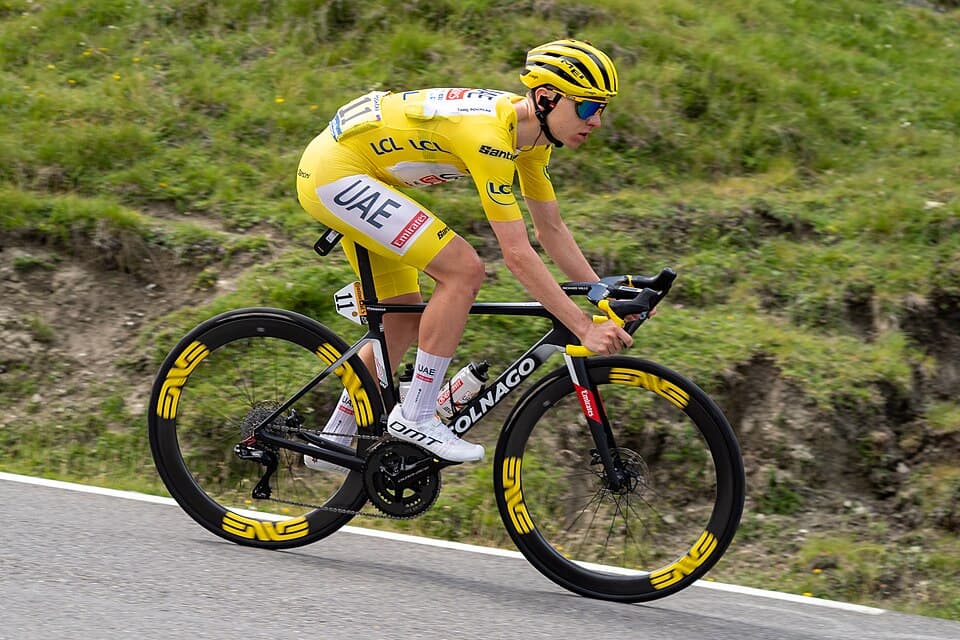
Tadej Pogačar did more than win the Tour de France's Bastille Day mountain stage. His attack on the Col de Pertus split the general-classification group, erased the last survivor of the breakaway and converted a difficult but still compressed race into one governed by a lead of three minutes and 36 seconds.
By Le Lioran, the yellow jersey had taken his third victory of this Tour, forcing every rival team to reconsider what a successful final fortnight could still look like.
Stage 10 was built to expose weak management after the rest day: 166.6 kilometres from Aurillac, roughly 3,800 metres of climbing and seven categorised ascents. A 31-rider break formed only after repeated attacks, yet UAE Emirates-XRG never let its advantage grow beyond 1:25.
That control made the front group expend energy without allowing it to become a strategic threat. The stage was being prepared for the favourites long before Pogačar made his move visible.
Javier Romo spent 36 kilometres alone before being caught at the foot of Puy Mary. Richard Carapaz then took over, driving his advantage to a minute by the base of the first-category Col de Pertus. Carapaz's attack had enough quality to win a stage under different race conditions; here, it became the target against which the yellow jersey could measure his own acceleration.
Visma-Lease a Bike increased the pace through Davide Piganzoli, but Pogačar attacked one kilometre from the Pertus summit and crossed the gap to Carapaz almost immediately. He was 20 seconds clear of the Vingegaard-Evenepoel-Seixas group over the top, then kept pressing across the final ascent of the Col de Font de Cère.
The important detail was not simply that nobody followed the first acceleration. The gap continued to grow after the terrain became less selective, evidence that the damage extended beyond one explosive minute.
Pogačar finished 32 seconds ahead of Remco Evenepoel, while Paul Seixas took third. Jonas Vingegaard reached the line in seventh place, 44 seconds behind the winner.
In the overall standings, Vingegaard now trails by 3:36 and Evenepoel sits third at 4:06. Those are no longer gaps that can be recovered through bonuses, positioning or one opportunistic descent; they demand a sustained failure from the leader or a mountain offensive capable of producing minutes.
The stage also rearranged the contest behind the two principal favourites. Isaac del Toro lost 1:31 and fell to seventh overall, while Evenepoel moved onto the podium, Seixas entered the top five and Juan Ayuso climbed ahead of both younger riders. UAE therefore gained time through Pogačar while losing a second high overall position, a trade that simplifies leadership but reduces the number of cards the team can play against long-range attacks.
The victory was Pogačar's 24th Tour stage win and made him the first rider to win three stages held on 14 July. That record carries symbolism, but the sporting achievement is sharper: three victories in the opening ten stages while wearing the burden of outright favourite. He has been able to contest stages without allowing the daily race for wins to weaken his control of the overall classification.
Control now changes sides. UAE can judge breaks by composition, defend selectively and make Visma spend riders before Vingegaard attacks. Vingegaard cannot wait for Pogačar to volunteer a bad day; his team must create repeated pressure, isolate the race leader and accept the counter-attacking risk that accompanies any move large enough to recover three and a half minutes.
Stage 10 did not settle the Tour, but it rewrote its economy: Pogačar owns time, and everyone else must spend energy to buy it back.