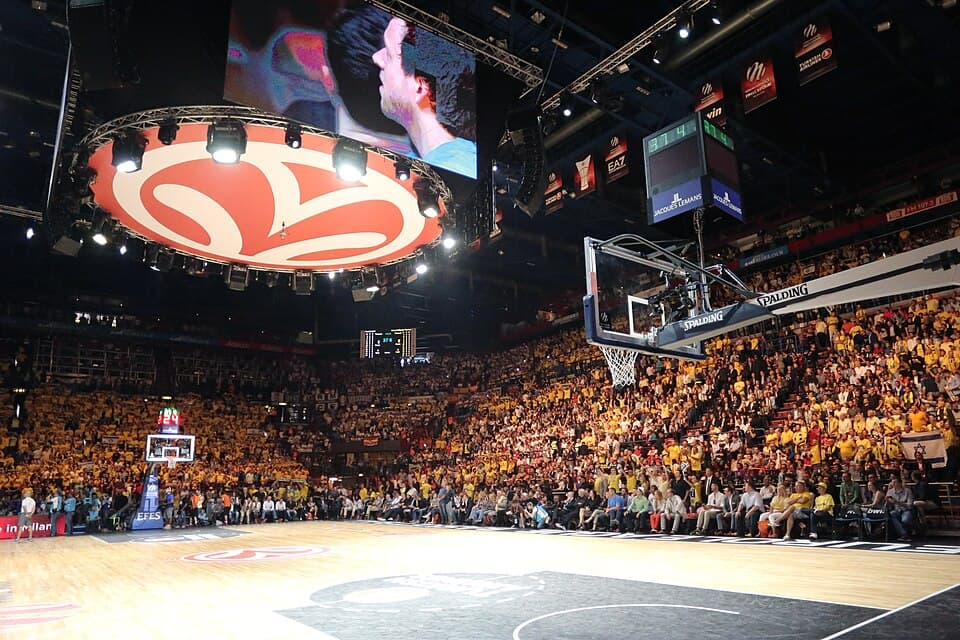
The Forum di Assago sits in an unglamorous industrial suburb just outside Milan, a hall built for concerts and conventions as much as basketball. On the evening of 18 May 2014 it turned, improbably, into an extension of Tel Aviv. Blue-and-yellow flags hung from every tier, Hebrew chants rolled down onto the court, and by tip-off close to twelve thousand fans packed a building whose capacity had been stretched to fit them — a large share of them Israelis who had crossed the continent on short notice, some buying up tickets originally allocated to Barcelona and CSKA Moscow supporters once those clubs were eliminated.
Nobody outside that crowd gave Maccabi much of a chance. Real Madrid arrived as the tournament's clear favourite, still chasing its first European title since 1995 and fresh off a runner-up finish the year before. Coached by Pablo Laso and stacked with talent — Sergio Rodríguez, Rudy Fernández, Nikola Mirotić, captain Felipe Reyes — Madrid had dismantled Barcelona 100–62 in the other semi-final. Maccabi, by contrast, had spent the season fending off criticism of head coach David Blatt after a rough patch domestically, and had needed a last-gasp basket from guard Tyrese Rice to squeeze past CSKA Moscow 68–67 in their own semi-final two nights earlier.
The final itself refused to break either way. Maccabi's starting five — Yogev Ohayon running the point, David Blu and Devin Smith on the wings, Alex Tyus and Sofoklis Schortsanitis, the giant Greek-Cypriot centre known across Europe simply as "Big Sofo," inside — matched Madrid basket for basket. Regulation time ended locked at 73–73, forcing the first overtime period in a Euroleague championship game since 1969.
It was in that extra five minutes that Rice, a lightly regarded American guard who had spent parts of his career bouncing around Europe's second tier, produced the performance of his life. He poured in a string of clutch shots as Maccabi pulled away, finishing with 26 points and claiming the Final Four MVP award. He did not do it alone: Ricky Hickman added 18, David Blu 14, Devin Smith 15, and Alex Tyus contributed 12 points, 11 rebounds and three blocks in the paint. When the buzzer sounded, the scoreboard read Maccabi Tel Aviv 98, Real Madrid 86.
"Unbelievable," Yogev Ohayon told reporters afterward. "I'm in complete shock." Devin Smith said the noise inside the Forum reminded him of Maccabi's own home floor, then known by its sponsor name as the "Nokia" arena in Tel Aviv. Blatt, who only months earlier had been fending off calls for his job, called it simply "an unbelievable season."
The scale of what had happened only became clear the next morning. This was Maccabi Tel Aviv's sixth European championship, joining the club's earlier titles from 1977, 1981, 2001, 2004 and 2005 — a run matched by only a handful of clubs in the competition's history. And it had come against the odds, on the road, against a Real Madrid side that many assumed was about to reclaim its old place at the top of the continent (Madrid would indeed do exactly that the following year, winning the 2015 title under Laso).
For a club and a country whose basketball glories had, by 2014, started to feel like distant memories from the Tal Brody era of the 1970s or the golden Final Four run of 2004 and 2005, the Assago final was proof the story wasn't finished. It was won not by a roster of superstars but by a group of journeymen and role players — Ohayon, Hickman, Tyus, Schortsanitis, Rice — welded together by a coach fighting for his own credibility, in front of a travelling support that had turned a suburban Italian arena into the loudest room in European basketball for one overtime period in May.
David Blatt would leave Maccabi within months to coach the Cleveland Cavaliers in the NBA. Real Madrid got its revenge a year later. But the banner from Assago still hangs in Tel Aviv, a reminder of the night the underdogs simply refused to lose.