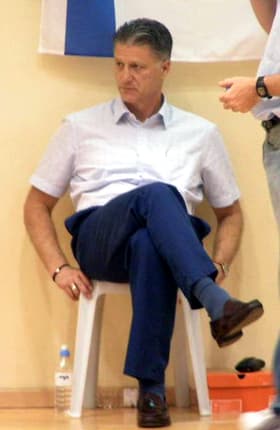
The family of Mickey Berkowitz, the man most Israeli basketball people still call the greatest player the country has ever produced, has revealed that the 72-year-old is living with dementia, ending a long period of silence about his health.
The disclosure came in a documentary titled "The Secret of Mickey Berkowitz," directed by veteran broadcaster Niv Raskin and shown Monday evening on Keshet 12, according to Ynet, Haaretz and Mako. The film identifies his condition specifically as Lewy body dementia.
"It's a type of dementia that damages cells in the brain and causes a person to lose things along the way," Raskin explained in the broadcast, describing how the disease has eroded Berkowitz's memory and independence over time.
His wife, Shelly, spoke with unusual candor about the diagnosis. "Unfortunately, he has one of the hardest sub-types of the disease, maybe the hardest," she said, describing the moment she first researched the condition online as one that left her badly shaken.
Their son, Roey, described the toll of watching his father change. "You see that it's not the father who raised you," he said. "It's still the same face, the same body, but the soul isn't quite the same thing."
According to Mako, rumours about Berkowitz's health had circulated in Israeli sporting circles for some time before the family decided to address them directly and openly through the documentary rather than let speculation continue.
Those close to the family told Ynet that symptoms first appeared roughly two and a half years ago, initially mistaken for vision problems, before the diagnosis of Lewy body dementia was confirmed. Berkowitz's public appearances have grown increasingly rare in recent years, and he now requires close supervision.
Berkowitz is not merely a basketball figure in Israel; he is close to a national symbol of the sport. Over a 24-year senior career he played for Maccabi Tel Aviv, Maccabi Rishon LeZion, Hapoel Jerusalem and Hapoel Tel Aviv, and he led Maccabi Tel Aviv to the club's first two European Cup titles, in 1977 and 1981.
With the Israeli national team he won the Asian Championship in 1974 and a silver medal at the European Championship in 1979. In 1975 he became the first Israeli to play NCAA Division I basketball, joining UNLV.
His standing in the global game was formally recognised well beyond Israel: he was named to FIBA's list of 50 greatest players in 1991, to EuroLeague's 50 greatest contributors in 2008, and was inducted into the FIBA Hall of Fame in 2017 — the first Israeli player to receive that honour. In 2024 he was awarded the Israel Prize for his contribution to Israeli sport.
Friends and former teammates have stayed close through the illness. Ynet reported that figures such as Moti Aroesti and Tal Brody remain in regular contact, at times taking Berkowitz on walks near his home, while people around Maccabi Tel Aviv have continued to visit him.
"He is surrounded by so much love, from his family, his devoted children and his wife," one person close to the family told Ynet, adding that it remains painful for those who knew him at his peak to see the change in him now.
The family's decision to go public is, by their own account, an attempt to take control of a story that was already circulating in fragments — and, they hope, to put a human face on a disease that remains poorly understood in Israel.