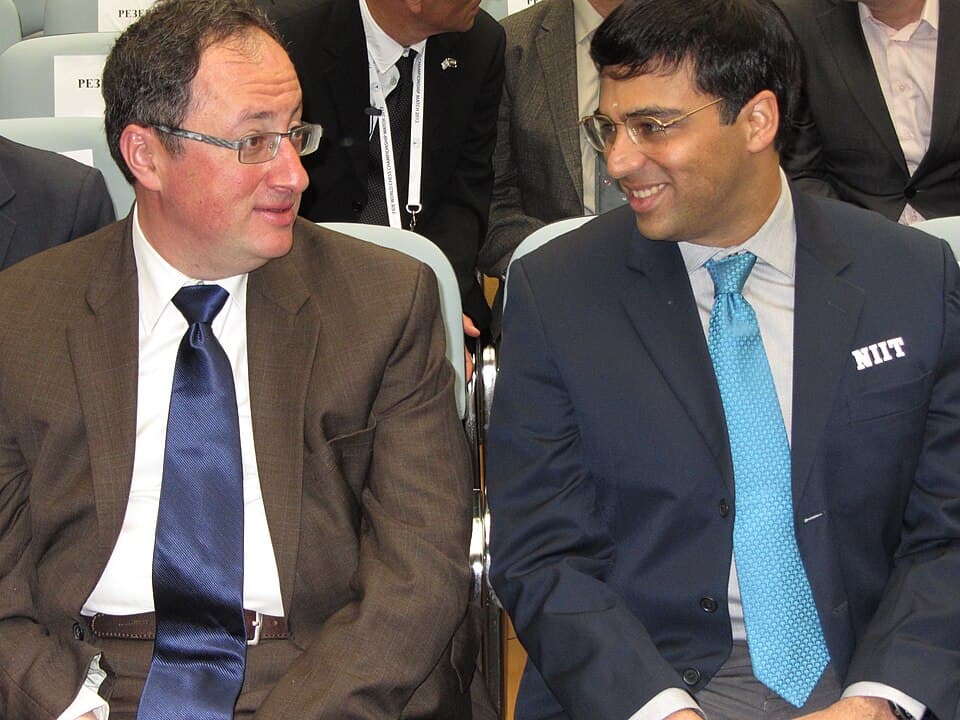
For three weeks in May 2012, inside the Engineering Building of Moscow's State Tretyakov Gallery, a 43-year-old immigrant from Minsk sat across a chessboard from the best player on earth and refused to lose. Boris Gelfand, ranked a modest 20th in the world against defending champion Viswanathan Anand's fourth, had no business being within touching distance of the World Chess Championship. By the time the match reached its final tiebreak day, he was one rapid game away from becoming Israel's first world champion in any sport governed by a global federation.
Gelfand's path to Moscow had been built on patience rather than flash. Born in Minsk in 1968, he was Soviet junior champion at 17 and European junior champion at 19, earning his grandmaster title in 1989 and cracking the world's top three by the summer of 1990. In 1998, with the Soviet chess machine gone and his career established, he emigrated to Israel and settled in Rishon LeZion, quietly becoming the country's highest-rated player for the next decade and a half while the game itself struggled for attention against Israel's football and basketball obsessions.
His route to a title shot ran through two grinding campaigns few outside chess noticed at the time: winning the 2009 World Cup in Khanty-Mansiysk, and then the eight-player 2011 Candidates Tournament in Kazan, where he eliminated Gata Kamsky, Shakhriyar Mamedyarov and finally Vladimir Kramnik to earn the right to challenge Anand. It made him, at 43, the oldest first-time world title challenger in decades — and the first Israeli to ever contest the sport's ultimate prize.
The match itself, backed by a $2.55 million prize fund, opened on 11 May 2012 and settled into a wary, high-precision stalemate. All twelve classical games ended in draws, six of them in fewer than 30 moves, as both men probed for the smallest structural edge and found none. It was, by the standards of elite chess, an unusually tense and airless contest — until Game 7 broke the pattern.
On 19 May, Gelfand beat Anand in 38 moves to take his only lead of the match, and Israeli chess fans allowed themselves, for the first time, to imagine the unimaginable. The response came almost immediately. In Game 8 the very next day, Anand won in just seventeen moves — the shortest decisive game in World Chess Championship history. Gelfand's queen, sent forward on an ambitious raid, was trapped by Anand's quiet 17.Qf2; Gelfand had calculated the position days earlier and simply missed the move over the board. He resigned within minutes, and the match was level again at 4–4.
Neither man could land another blow across the remaining four classical games. The scoreline held at 6–6 after twelve games, sending the championship to a rapid-play tiebreak on 30 May — a format that favoured Anand, the sharper and more experienced speed player. Anand won the first tiebreak game outright; the next three were drawn. He took the playoff 2½–1½, and with it the match, 8½–7½, retaining his title for a third consecutive defence.
Gelfand flew home to a reception no Israeli chess player had ever received. Dozens of fans and children from his hometown met him at Ben Gurion Airport carrying signs reading "Gelfand, ATA TOTACH" — Hebrew slang for "you're awesome." Asked what had decided the match, he was characteristically understated: "It was simply a matter of luck." He used the moment to press a different point, telling reporters that chess in Israel was still "regarded as a pastime for elderly people in the park" and calling for state investment in young talent.
No Israeli has come as close to a world chess title since. Gelfand continued competing for Israel at the top level for another decade, representing the country at Olympiads from Dresden to Istanbul, but the 2012 match in Moscow remains the high-water mark: twelve classical games without defeat against the world's best player, undone in the end by seventeen moves and a single queen that wandered one square too far.