On the evening of 3 June 1964, roughly 35,000 people packed Ramat Gan Stadium — the largest crowd the tournament would draw — to watch Israel try to finish what it had started five days earlier. This was the third AFC Asian Cup, the first ever staged outside East or South Asia, and Israel was both host and unbeaten leader of a four-team round-robin that had been whittled down from seventeen original entrants after a wave of withdrawals during qualifying.
Israel had opened the tournament on 26 May with a tight 1-0 win over Hong Kong at Ramat Gan, then travelled to Bloomfield Stadium in Tel Aviv three days later to beat India 2-0. That left one final test: South Korea, twice champions of Asia and chasing a third straight title. A win for Israel would clinch the tournament outright; anything less would open the door for the Koreans.
It did not stay close for long. Moshe Leon put Israel ahead after twenty minutes, and Gideon Tish doubled the lead before halftime. South Korea pulled a goal back in the second half, but the deficit held: Israel won 2-1 and finished the tournament with a perfect record — three matches, three wins, six points — to be crowned champions of Asia for the only time in its history.
Among the Israeli side that week was a nineteen-year-old forward from Netanya named Mordechai Spiegler, who had made his international debut against Hong Kong barely five months earlier. He finished the tournament with two goals, level with India's Inder Singh as joint top scorer. It was an early glimpse of a career that would define a generation of Israeli football: Spiegler went on to play for Paris Saint-Germain and, in the 1970s, alongside Pelé for the New York Cosmos, and in 1970 he scored Israel's only goal in its only World Cup finals appearance, a 1-1 draw with Sweden in Mexico. He remains Israel's all-time leading scorer with 32 international goals.
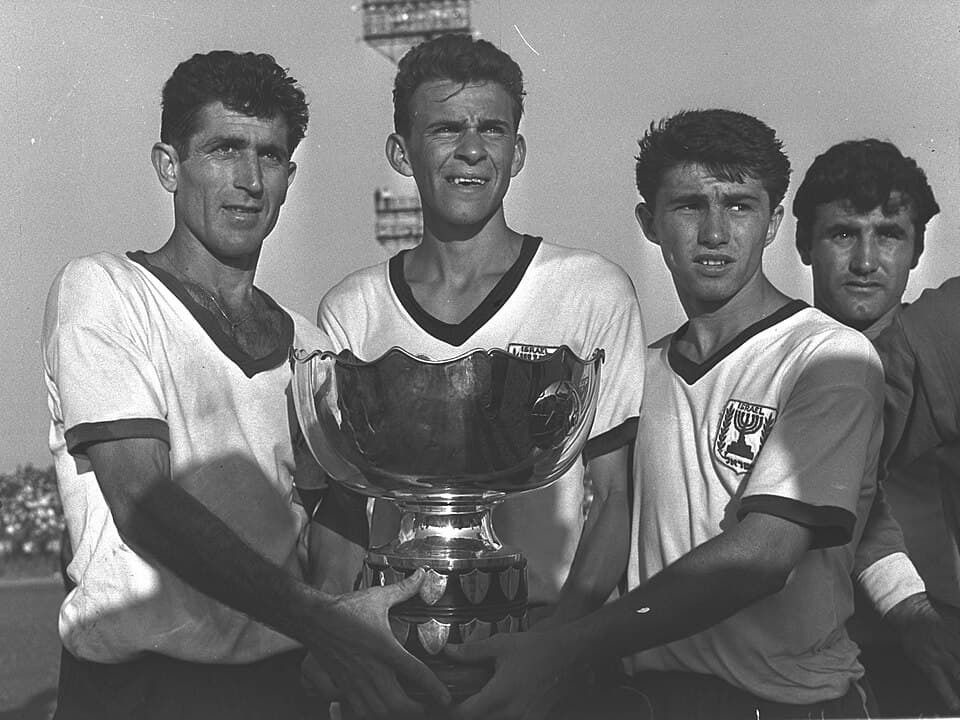
The trophy itself was presented amid a burst of national pride. President Zalman Shazar attended the closing ceremony at Ramat Gan alongside the heads of the Asian football federations then in Israel — a reminder that in 1964, Israel's place inside Asian football was not merely accepted but actively hosted and celebrated. Government photographer Moshe Pridan captured the team hoisting the cup, images that survive today in Israel's National Photo Collection.
It was, in context, the culmination of a run of near-misses. Israel had finished runners-up at the Asian Cup in both 1956 and 1960, losing out each time to South Korea. The 1964 title, won on home soil with a squad drawn mostly from Maccabi Tel Aviv, Hapoel Tel Aviv and Hapoel Petah Tikva under coach Yosef Merimovich, was the breakthrough those two silver medals had been building toward — and across all six Asian Cup matches that fortnight, a combined 99,000 spectators had turned out, an average of roughly 16,500 per game, in a country of barely two and a half million people.
Israel remained an Asian football nation for another decade, finishing third at the 1968 Asian Cup before withdrawing as scheduled 1972 hosts amid mounting political pressure. That pressure came to a head in September 1974, when Kuwait tabled a motion at the AFC congress to expel Israel from the confederation; it passed 17 votes to 13, with six abstentions, following a tense build-up that included a hostile final against Iran at that year's Asian Games in Tehran.
Israel spent the following years as a footballing nomad, shuffled into Oceania's qualifying pathway before eventually being welcomed into UEFA — first on a provisional basis in 1991, then as a full member on 31 May 1994. Israeli clubs and the national team have played as a European entity ever since.
Which is what makes 3 June 1964 such an unrepeatable date. Because Israel no longer competes for the Asian Cup, the trophy the team lifted in Ramat Gan that evening can never be defended again in the competition it was won in — a continental title frozen permanently in the record books as Israel's only one. Six decades later, it stands as the strange, singular souvenir of a chapter of Israeli sport that history quietly closed the door on.