Five days after the final whistle in the 2026 World Cup, an uncomfortable question is being asked about the tournament's integrity: did anyone try to manipulate a match, and would anyone even know?
ONE reports that the Group of Copenhagen, an independent sports-betting monitoring body linked to the Council of Europe, tracked all 104 matches of the finals and singled out seven cases as "yellow alerts" — its second-lowest tier, denoting multiple indicators of irregularity that fall well short of proof but warrant a closer look. Fifteen matches in total received extra scrutiny, concentrated around the tense finish to the group stage, with twelve separate incidents examined for integrity risk.
The findings sit awkwardly alongside FIFA's own account. The governing body's Integrity Task Force has stated flatly that it identified "no suspicious betting activity or indications of match manipulation" in any fixture across the entire competition — a direct contradiction the Group of Copenhagen's report does not shy away from.
The most detailed case involves Folarin Balogun. The United States forward was shown a red card, and on July 2 the prediction-market platform Polymarket opened a market asking simply whether he would play against Belgium — three days before FIFA's Disciplinary Committee confirmed his suspension had been lifted. According to the report, no comparable betting market appeared for any of the other fourteen players sent off during the tournament, none of whom had their bans suspended.
A second flagged case centres on Spain's goalless group-stage draw with Cape Verde, where roughly $4.8 million was staked on Polymarket against Spain winning outright — a striking sum for a fixture pitting a heavy favourite against a World Cup debutant.
Spain features again in a third case: a VAR review lasting some three and a half minutes before a Ferran Torres goal was ruled out in the team's 4-0 win over Saudi Arabia. The delay itself, rather than the eventual decision, drew the monitor's attention.
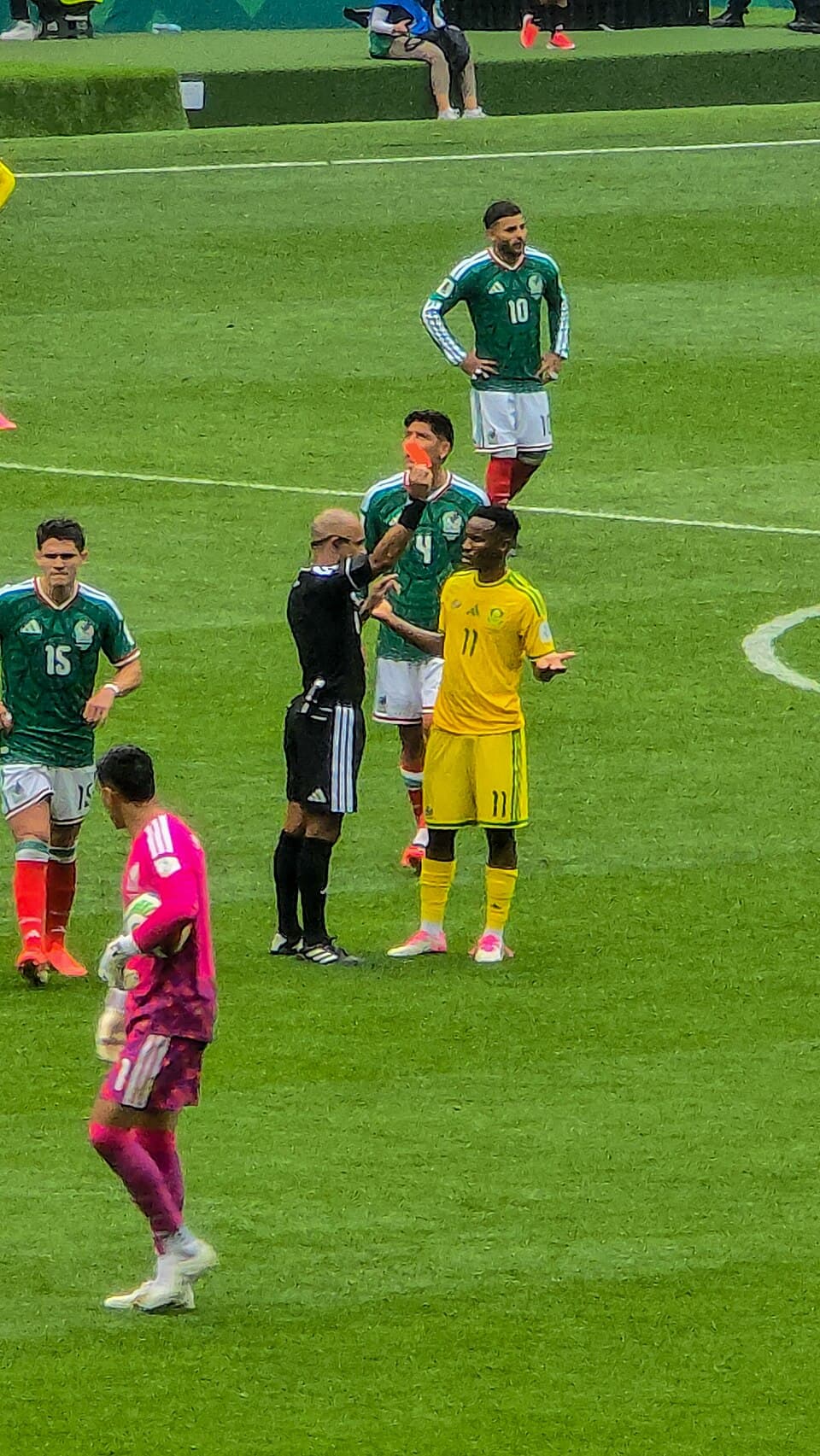
The opening match of the tournament also made the list. South Africa's Themba Zwane was sent off in the 84th minute of the Group A curtain-raiser against Mexico, an incident the report includes among its seven flagged episodes.
None of this amounts to an allegation that any player, official or match was actually corrupted. A yellow alert, in the Group of Copenhagen's four-tier scale running from green through yellow and orange to red, is explicitly a trigger for further review rather than a finding of wrongdoing — it can be set off by nothing more sinister than an unusual swing in odds or a rumour circulating on social media.
What has amplified the story is scale. The Group of Copenhagen estimates roughly $240 billion was wagered worldwide on this World Cup, close to double the amount bet on Qatar 2022 — a market large enough that even minor statistical anomalies attract attention, and one prediction markets like Polymarket have made far more visible than in previous tournaments.
FIFA has not publicly detailed how it reconciles its own clean assessment with the Council of Europe-linked body's findings, and no disciplinary or criminal process has been opened over any of the seven cases. For now, the story is one of two respected integrity processes reaching different conclusions from the same tournament — not evidence that a World Cup match was fixed.