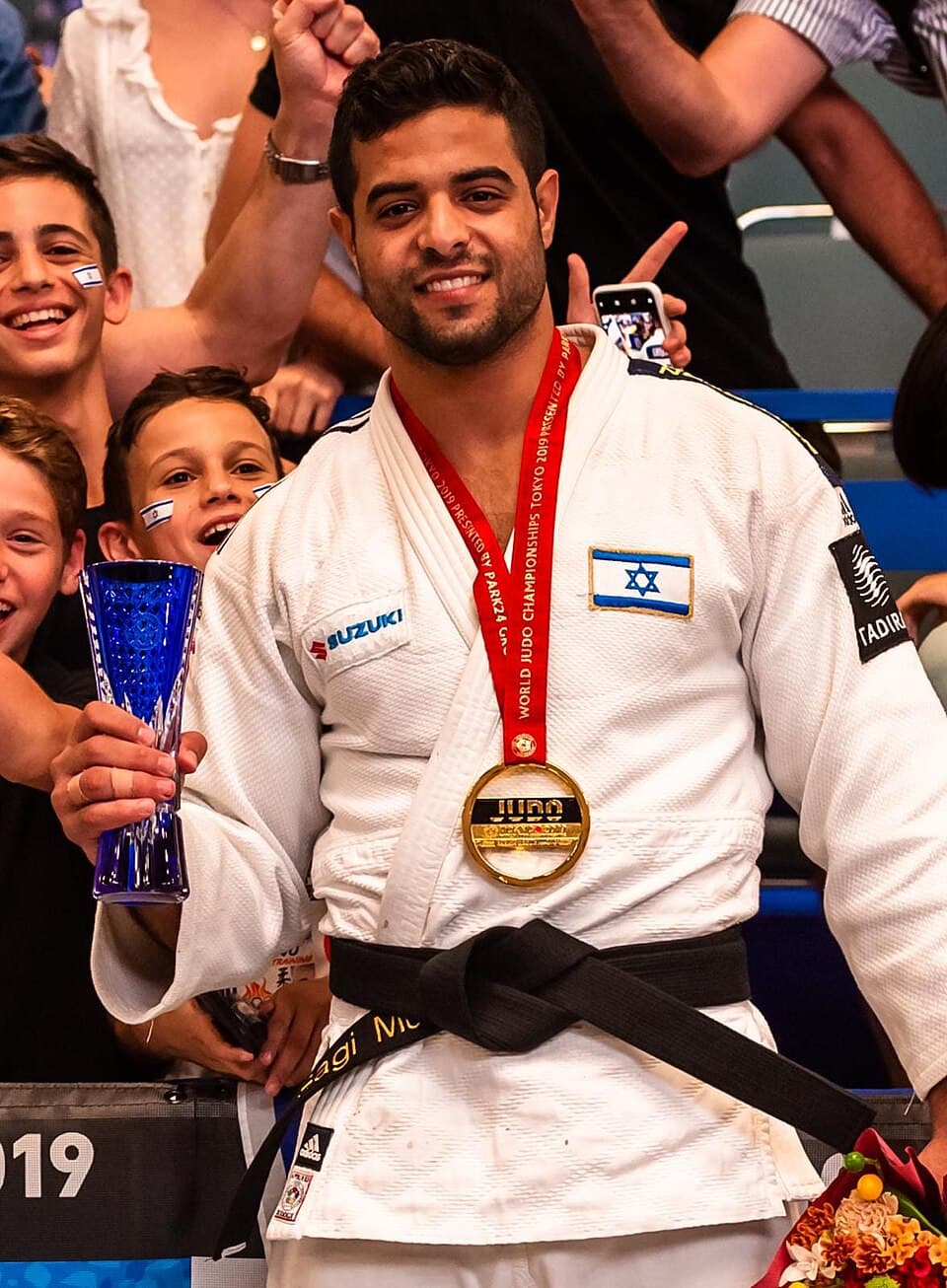
The Nippon Budokan is judo's cathedral, the arena Kanō Jigorō's sport built its Olympic legend in back in 1964, and on 28 August 2019 it was host again — this time to the World Judo Championships, a dress rehearsal for the Tokyo Games less than a year away. In the men's under-81 kilogram category, Israel's Sagi Muki, a two-time European champion who had already spent a decade fighting his way toward this exact mat, was seeded among the favourites. By the end of the day he would be a world champion. The manner of it — and the story unfolding out of sight on the other side of the draw — would make the date one of the most quietly extraordinary in Israeli sporting history.
Muki tore through the early rounds. He won his first four bouts by ippon, judo's cleanest kill — a full point, fight over, no need for the judges. It was the form of a man who had waited a long time for this moment: a herniated disc had cost him a shot at the Rio Olympics in 2016, and he had rebuilt himself since, winning European titles in 2015 and 2018 and climbing back to the top of the world rankings.
The semi-final brought Egypt's Mohamed Abdelaal, and a tighter contest — Muki won it by waza-ari, judo's half-point, rather than ippon. It also brought an ugly coda. When the bout ended, Muki offered his hand. Abdelaal turned and walked off the mat without taking it, a scene that echoed Egyptian judoka Islam El Shehaby's refusal to shake Israeli Ori Sasson's hand at the Rio Olympics three years earlier. Muki's response afterward was measured rather than triumphant: he said he was sorry Abdelaal hadn't shaken his hand, and that he was pleased to have shown, in his words, "the beautiful face of Israel." Egypt's own foreign ministry later criticised Abdelaal's conduct.
In the final, Muki faced Belgium's Matthias Casse, the reigning European champion. It was close — by Muki's own account afterward, he came near to losing and had to dig for everything he had. He got there with 1 minute 21 seconds left on the clock, throwing Casse for a fifth ippon in six fights that day, this one built from two waza-ari scores stacked into a full point. Muki dropped to the mat, then rose to be draped in the Israeli flag as Hatikvah played inside the Budokan. "This is my first time as world champion, and it's a very special moment for me," he said. "I finally did it." Prime Minister Benjamin Netanyahu sent his congratulations, praising Muki for "bringing a lot of respect and pride to all of us."
It was only Israel's second world judo title, and its first won by a man. The first had come six years earlier and half a world away, when Yarden Gerbi won gold at -63kg at the 2013 World Championships in Rio de Janeiro, choking out France's Clarisse Agbegnenou in the final. Muki's win in Tokyo placed him alongside her in a very short list.
But the full shape of 28 August 2019 didn't become clear until later. On the other half of the draw, Iran's Saeid Mollaei — the reigning world champion, and the man many expected to meet Muki in the final — had been drawn to face Casse in the semi-final. He lost. At the time it looked like an ordinary defeat. It was not. Mollaei later told the International Judo Federation that Iranian officials had pressured him for days to avoid a possible bout against an Israeli, and that Iran's Olympic Committee president warned him, minutes before he stepped onto the mat, that security officials were at his parents' house in Tehran. Mollaei said he deliberately threw the semi-final to Casse, then lost his bronze-medal bout as well, leaving the tournament without a medal rather than risk facing Muki.
Mollaei went public with the story after the championships, telling the IJF he was too afraid to return to Iran. The federation's investigation corroborated his account and led to a four-year suspension of Iran's judo federation over its long-standing policy of forcing athletes to withdraw rather than compete against Israelis. Mollaei sought asylum, eventually settling in Germany; he went on to compete under the Mongolian flag and later for Azerbaijan.
What makes the story remarkable is what came after the politics. Muki and Mollaei, drawn together by a scandal neither of them chose, became friends — genuine ones. They finally faced each other on a judo mat for the first time at the Budapest Grand Slam in 2021, more than two years after Tehran had made sure it wouldn't happen in Tokyo. Mollaei won that bout. The two embraced afterward, and Mollaei later told interviewers he would never forget the kindness the Israeli team had shown him when he had nowhere else to turn.
Muki's own career kept climbing. Two years after Tokyo 2019, he returned to the Nippon Budokan for the delayed 2020 Olympics and won bronze in judo's inaugural mixed team event, adding an Olympic medal to his world title. But 28 August 2019 remains the pivot: the day an Israeli man stood on top of a judo world championship podium for the first time, in a story that turned out to be as much about the fight he never had to have as the ones he did.