The Palais Omnisports de Paris-Bercy filled with blue and white on the evening of 13 May 2001, as Maccabi Tel Aviv took the floor for a rematch few in Israeli basketball needed reminding of. A year earlier, in Thessaloniki, this same fixture had ended in heartbreak.
In the 2000 EuroLeague final, Panathinaikos beat Maccabi 73-67, and the dagger was thrown by a familiar face. Oded Kattash, a Maccabi favourite who had crossed to the Greek club the previous season, drilled a three-pointer that put Panathinaikos ahead for good and closed the game at the free-throw line. So beloved was Kattash in Tel Aviv that Maccabi fans who ran into him at the airport afterwards embraced him anyway — a small, telling moment in a rivalry that ran through families as much as flags.
Coach Pini Gershon spent the following season rebuilding around a core that mixed Israeli continuity with imported firepower. Nadav Henefeld and Tal Burstein anchored the forward positions, with Regev Fanan, Gur Shelef and Elad Savion filling out the roster, while American guard Ariel McDonald, forward Anthony Parker and centre Nate Huffman carried the scoring load. On the bench beside Gershon sat assistant coach David Blatt, who had helped recruit Parker to the club a year earlier and would go on to his own long coaching career.
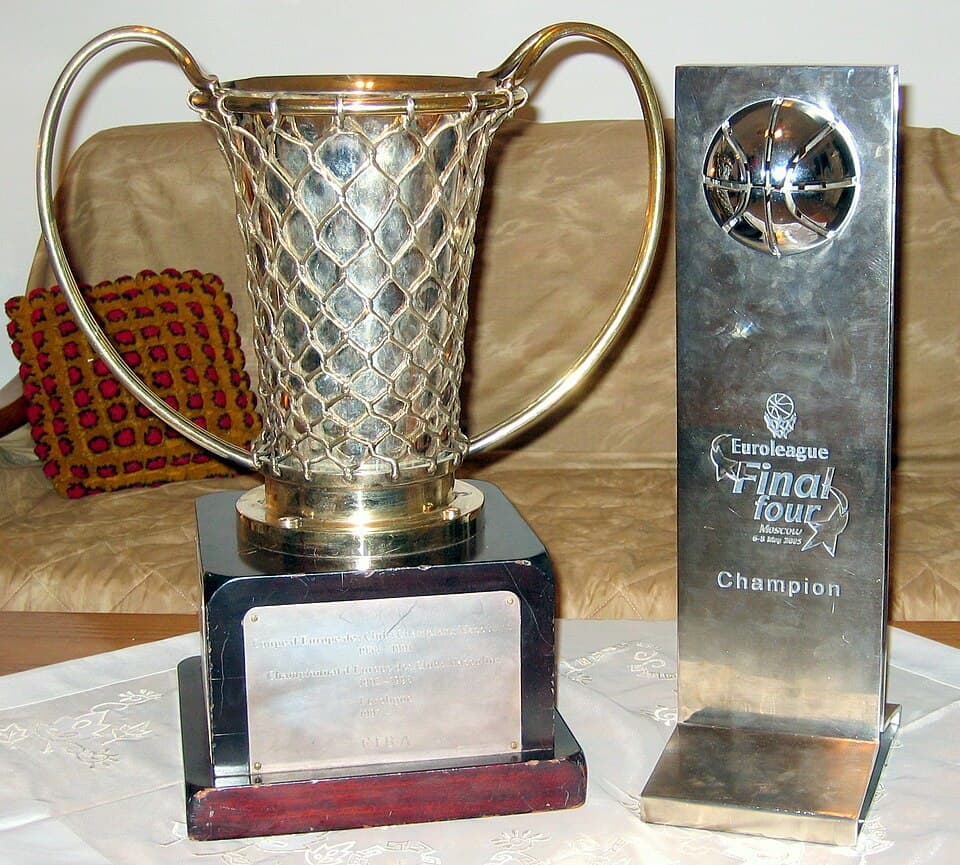
That season, Europe's elite clubs were split across two rival competitions after a breakaway by clubs backed by ULEB. Maccabi and Panathinaikos played in the FIBA-organised SuproLeague, while Kinder Bologna lifted the parallel ULEB EuroLeague crown the same month. The two competitions would merge into a single EuroLeague the following season — but the Bercy title has always counted, in Maccabi's own history and the EuroLeague's official records, as one of the club's continental championships.
Maccabi reached the final by beating CSKA Moscow 86-80 in the semifinal on 11 May, while Panathinaikos got past Efes Pilsen 74-66 on the same night, setting up the rematch Tel Aviv had waited a year for.
On final day, Maccabi never let the Greeks find their footing. McDonald ran the offence with poise, finishing with 21 points and 9 assists to be named Final Four MVP, while Huffman bullied the paint for 21 points and 9 rebounds — form that would also earn him the SuproLeague's Player of the Year award that season. Parker chipped in 13 points, and all three were named to the tournament's All-Final Four team as Maccabi closed out an 81-67 win.
It was Maccabi's third European title, and its first since 1981 — a wait of exactly twenty years, bridging the era of Tal Brody and Motta Aroesti to a new generation built by Gershon.
The win also began a run that would define Israeli basketball's proudest European stretch. Gershon reached the continental final in every one of his five full seasons in charge of Maccabi, winning three of them, with the club going on to add back-to-back titles in 2004 and 2005 before a sixth crown followed in 2014.
For a small basketball nation whose top clubs rarely got to test themselves against the continent's giants on even terms, the scoreline from Bercy — and the year of hurt it erased — became one of the touchstones Israeli fans measure every later triumph against.