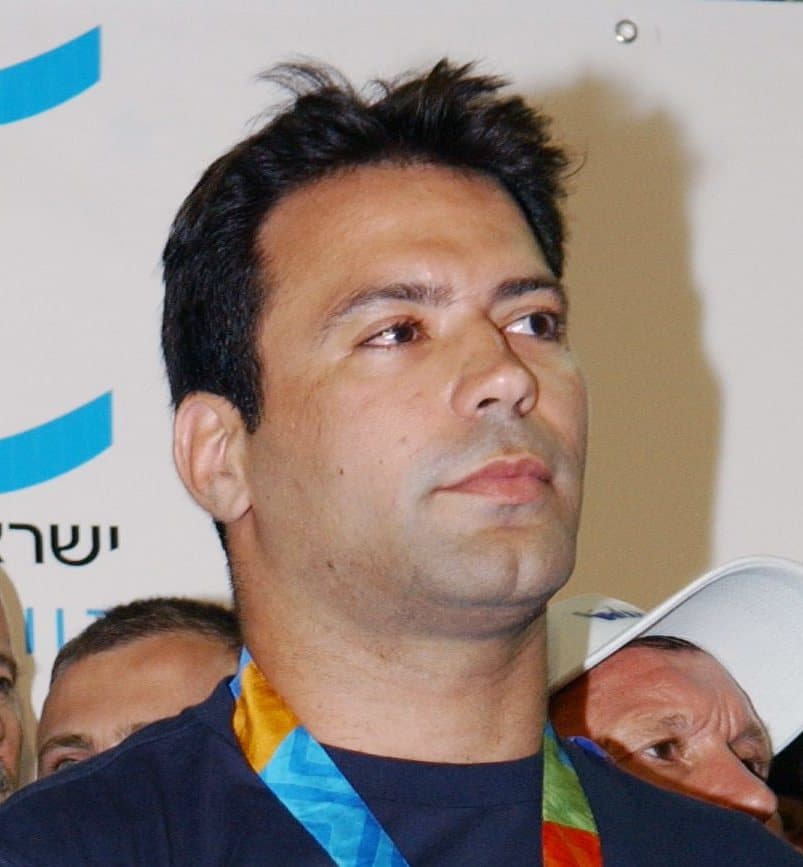
On the morning of 19 August 2004, in the packed and sweltering Ano Liossia Olympic Hall on the northern edge of Athens, Ariel "Arik" Ze'evi walked out for a bronze-medal contest that would make him, however briefly, the answer to a trivia question: the man who won Israel's first medal of the Athens Olympics.
Ze'evi arrived in Athens with a pedigree few Israeli judoka could match. Born on 16 January 1977 in Bnei Brak and raised through the Hapoel Bnei Brak judo club, he had already won the European title twice, in 2001 and 2003, and had carried the Israeli flag at the opening ceremony days earlier — a recognition of a decorated career that, at the Olympic level, had so far produced only a fifth-place finish at Sydney 2000.
The men's 100kg draw did not go cleanly for him. In the semifinals, Ze'evi lost by ippon to South Korea's Jang Sung-ho, a result that would ordinarily end a competitor's day. Olympic judo, though, offers a second life through the repechage, and Ze'evi took it. He beat Cameroon's Franck Martial Moussima, then defeated France's Ghislain Lemaire — at the time ranked second in the world — to earn his place in the bronze-medal bout.
Waiting across the tatami was Elco van der Geest of the Netherlands. The contest did not go the distance: Ze'evi threw him for ippon, the clean, decisive score that ends a judo match outright, and stood as an Olympic medalist for the first time in his career.
It was a modest medal by the raw arithmetic of a Games table — one bronze, in a half-heavyweight division that rarely makes front pages. But its timing gave it outsized weight at home. It was the first medal won by any Israeli athlete at the Athens Olympics, arriving five days before windsurfer Gal Fridman's gold turned the country's attention fully to the Games. For a few days in late August 2004, Ze'evi's bronze was the whole of Israel's Olympic story.
The medal also closed a personal loop. Ze'evi had gone to Sydney four years earlier as a promising 23-year-old and come home with nothing to show for it beyond a fifth-place finish. Athens, contested in front of Greek crowds in a hall built for exactly this kind of drama, turned him from a nearly-man into an Olympic medalist — and did so on Israeli judo's biggest individual stage since Yael Arad's and Oren Smadja's medals in Barcelona twelve years before.
Ze'evi's career did not end in Athens. He added two further European titles, in 2004 itself and then, remarkably, in 2012 at the age of 35 — a title that made him a four-time European champion, a record among Israeli judoka. He returned to the Olympics twice more, at Beijing in 2008, where he fell in the repechage without a medal, and at London in 2012, where his final Olympic bout lasted only 43 seconds before a loss to Germany's Dimitri Peters.
None of those later Games produced another medal. The bronze from the Ano Liossia hall on 19 August 2004 remained, to the end of his competitive career, Ze'evi's only Olympic podium finish — a single afternoon that made him, for a few days at least, the face of Israel's Olympic effort, before the country's gaze shifted to the water off Saronic Gulf and to the gold that followed.