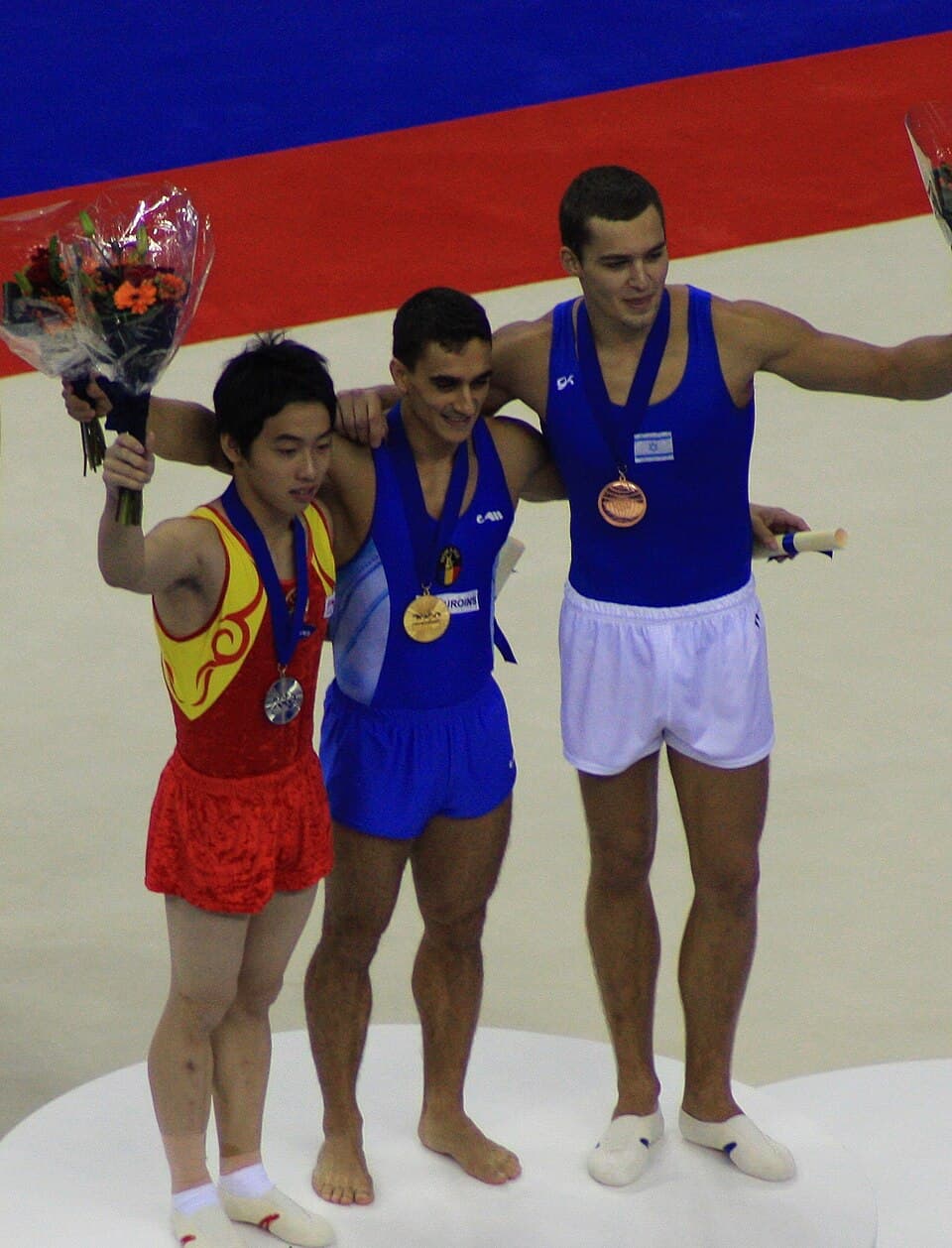
The apparatus finals at the 2009 World Artistic Gymnastics Championships opened on a Saturday afternoon at The O2 Arena in London, and the very first routine on the schedule belonged to the men's floor exercise. It was 17 October, the sixth day of a championship that had already crowned its all-around winners, and the arena was settling into the rhythm of one final after another. Few in the crowd expected the floor final to be remembered as anything more than an undercard to the bigger vault and horizontal-bar finals still to come that week.
Among the eight gymnasts walking out to compete was Alexander Shatilov, a 22-year-old wearing Israel's colours. He had been born in Tashkent, in the Uzbek Soviet Socialist Republic, on 22 March 1987, and had moved to Israel with his family in 2002 as a teenager already deep into gymnastics training. In Israel he came under the wing of national coach Sergei Vaisburg, who helped sharpen him into one of the sport's most explosive tumblers — a specialist on a single apparatus in a discipline where all-around versatility usually wins the headlines.
The field he faced was not a soft one. Marian Drăgulescu of Romania, a veteran floor and vault specialist who had already won world titles on both apparatus in his career, was among the favourites. So was Zou Kai of China, then the reigning Olympic champion on floor from Beijing the year before and a member of the all-conquering Chinese men's team. Against that company, Israel — a country that had never once medalled at a World Artistic Gymnastics Championships in its history — had, in Shatilov, its first realistic contender.
When the scores were posted, Drăgulescu had done enough to take gold with 15.700, with Zou Kai a whisper behind on 15.675 for silver. And in third place, at 15.575, was Shatilov — good enough for bronze, and good enough to make history. It was, by a matter of hundredths of a point across the podium, one of the tightest finals of the championships, and Israel had landed on the right side of it.
The result made front-page sports news back home. Haaretz reported it plainly the next day under a headline that captured its significance: Shatilov had won Israel's first-ever medal at a World Gymnastics Championships. It was not a qualified claim or a footnote — Israeli gymnasts, men and women, had competed at world championships for decades without ever standing on that podium. Shatilov's bronze, earned on tumbling pass after tumbling pass under London's lights, closed that gap in one afternoon.
It was not a fluke either. Six months earlier, Shatilov had already won bronze on floor at the 2009 European Championships in Milan, a sign that his run to a world medal was building rather than arriving out of nowhere. And two years later, in Tokyo, he proved London was no one-off: he took bronze again in the floor final at the 2011 World Championships, tying Brazil's Diego Hypolito at 15.466, behind Kohei Uchimura of Japan and China's Zou Kai once more.
Over the following decade Shatilov built one of the most durable careers in Israeli gymnastics, collecting European Championship medals on floor almost every year he competed — bronze in 2009 and 2012, silver in 2011, a shared gold in Moscow in 2013, and further bronzes in 2014, 2016 and 2017. He became, in effect, Israel's first gymnastics institution: a name reporters and rivals alike came to expect on finals day.
The London bronze mattered beyond Shatilov's own medal count. For years afterward, Israeli gymnastics officials pointed to it as proof that a small federation with limited funding could still produce a world-class specialist, and it helped justify continued investment in the discipline through the years that followed. When Artem Dolgopyat went on to win Israel's first Olympic gymnastics gold in Tokyo in 2021, and then Israel's first-ever World Championships gold on floor in Antwerp in 2023, both achievements stood on ground that Shatilov's bronze had first cleared.
None of it was inevitable back on 17 October 2009. Shatilov was a teenage immigrant from Tashkent representing a country with no history of gymnastics medals, competing on the year's biggest stage against an Olympic champion and a two-time world champion on the very apparatus he had built his career around. He did not need to win gold to make the moment matter. He needed only to land, cleanly, in third — and Israeli gymnastics has been standing on that platform ever since.