Two years to the week since a rocket fired from Lebanon tore into a football pitch in Majdal Shams and killed 12 children, the small Golan Druze club that lost three of its own players in the strike says it has not just survived the tragedy but grown through it, ONE reports.
Bnei Mamba is not a conventional club name but an acronym drawn from the four Druze villages of the northern Golan Heights it represents — Masaada, Majdal Shams, Buq'ata and Ein Qiniya. What began as a single senior side in the mid-2010s has, even through catastrophe, become the sporting backbone of the whole plateau.
On the afternoon of July 27, 2024, a missile struck the football field in Majdal Shams while children and teenagers were playing. Twelve were killed and dozens more wounded in one of the deadliest single strikes on Israeli territory since the war on the northern front began. Israel and Western governments attributed the rocket to Hezbollah; the group denied firing it, blaming an errant Israeli air-defense interceptor instead — a dispute that remains unresolved.
Three of the twelve who died were Bnei Mamba players: Amir Abu Saleh, 16, Hazem Abu Saleh, 15, and Johnny Ibrahim, 13. Their deaths on their own pitch, in the colors of their own club, left a wound the community is still living with.
"The disaster continues to accompany our thoughts," the club's coach, Wajdi Alqish, told ONE. "We lost players; this will follow us our whole lives."
Yet the numbers Alqish now oversees tell a story of stubborn expansion rather than retreat. Bnei Mamba fields eight boys' teams — including a youth side competing in the national league — alongside two girls' teams, a girls' youth team and a veterans' squad, according to the club.
"We continue to play, grow and develop," Alqish said. "Our club models coexistence — children from regional kibbutzim now want to join us. These are the best responses to murderous terrorism."
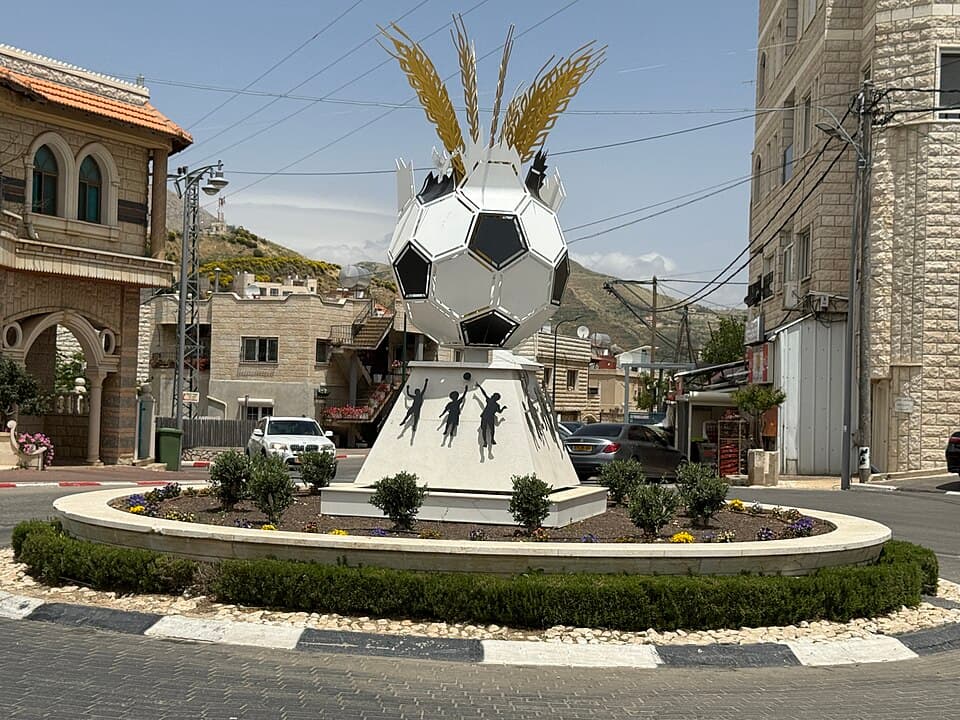
A memorial ceremony was held in Majdal Shams this week marking two years since the strike, attended by relatives of the victims and local officials. A monument shaped like a football now stands in the square beside the pitch, dedicated to the twelve children who were killed there.
The pitch itself was rebuilt and reopened in a ceremony in August 2025, its reconstruction funded in part by donor families from abroad, the Jerusalem Post has reported, turning the site of the attack back into the place where Bnei Mamba's teams train and play.
For a club that could easily have folded under the weight of what happened on its own field, the growth Alqish describes — more teams, more players, more communities drawn in — stands as the Golan's own quiet answer to the attack that defined it two years ago.