The mat at Carioca Arena 2 does not care about politics. That is the whole premise of judo, a sport built on bows and grips and the assumption that two strangers who have just tried to throw each other to the floor will, when it is over, shake hands. On the afternoon of 12 August 2016, that assumption broke in full view of a near-capacity Rio crowd, and Or Sasson was standing in the middle of it.
Sasson, a 25-year-old Israeli heavyweight, had drawn Egypt's Islam El Shehaby in the round of 32 of the men's over-100kg category. It was their first meeting. Sasson won it clearly, throwing El Shehaby twice, and turned to offer the customary handshake and bow that closes every judo contest. El Shehaby backed away, shaking his head, and walked off the mat to a chorus of boos. The referee called him back and ordered him to bow; he gave a brief, grudging nod and left again, still booed.
"I was educated to respect my opponents, no matter who they are," Sasson said afterward. "We always shake hands at the end of the fight. I stretched out my hand, but he didn't go with it." His coaches, he later admitted, had warned him it might happen. It did not stop him competing. "I knew to put that incident aside," he said. "Politics doesn't matter when I'm on the mat."
The incident traveled far faster than the tournament itself. The International Olympic Committee's Disciplinary Commission opened a review and, days later, issued El Shehaby a "severe reprimand for inappropriate behaviour," ruling that his conduct was "contrary to the rules of fair play and against the spirit of friendship embodied in the Olympic Values." The Egyptian Olympic Committee sent him home before the closing ceremony. El Shehaby, for his part, was unrepentant, saying a handshake was not an obligation written into judo's rules and that it happens between friends. He announced his retirement from judo soon after.
For Sasson, the story did not end with the walk-off. He still had a tournament to win. He beat his way through the next two rounds before running into Teddy Riner in the semifinal — the Frenchman who would leave Rio unbeaten in more than a decade of major competition, a wall of a man en route to his second Olympic gold. Sasson lost by waza-ari, but Riner shook his hand warmly at the final bell, a small and pointed contrast to the morning's headlines.
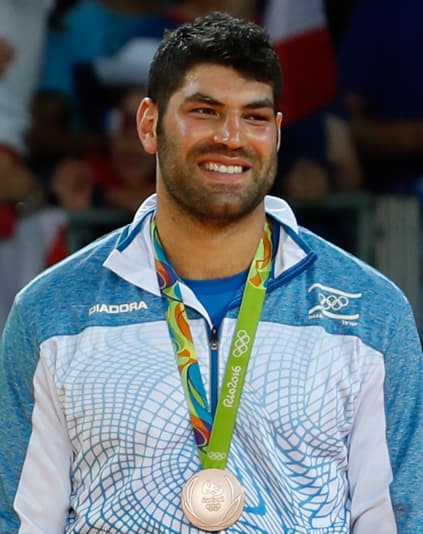
That defeat sent Sasson into the bronze medal bout against Cuba's Alex García Mendoza, a tight, grinding contest with almost no clean scoring chances from either man. It was decided, in the end, on penalties — the kind of unglamorous, attritional finish that heavyweight judo often produces when two exhausted competitors refuse to give the other an opening. Sasson had fewer penalties. He had his medal.
It was Israel's second bronze of those Games, both won in judo within four days of each other: Yarden Gerbi had taken the first, in the women's 63kg category, on 9 August, ending a twelve-year wait for an Israeli medal at a single Olympics being doubled up. Sasson's medal was his first Olympic podium finish — he would add a second, in the mixed team event, five years later in Tokyo — and it made him, that week, one of the most searched Israeli athletes in the country's Olympic history, for reasons that had almost nothing to do with judo technique.
What lingers from that day is not really the scoreline against García Mendoza, tight as it was. It is the split-second on the mat when El Shehaby turned his back, and the split-second after, when Sasson's hand was still out. Broadsheets from the BBC to CNN to Al Jazeera ran the image; Israeli papers followed Sasson through the rest of the draw. The bow that never came became, briefly, bigger than the Games themselves. The bronze that did come was the part Sasson actually built.