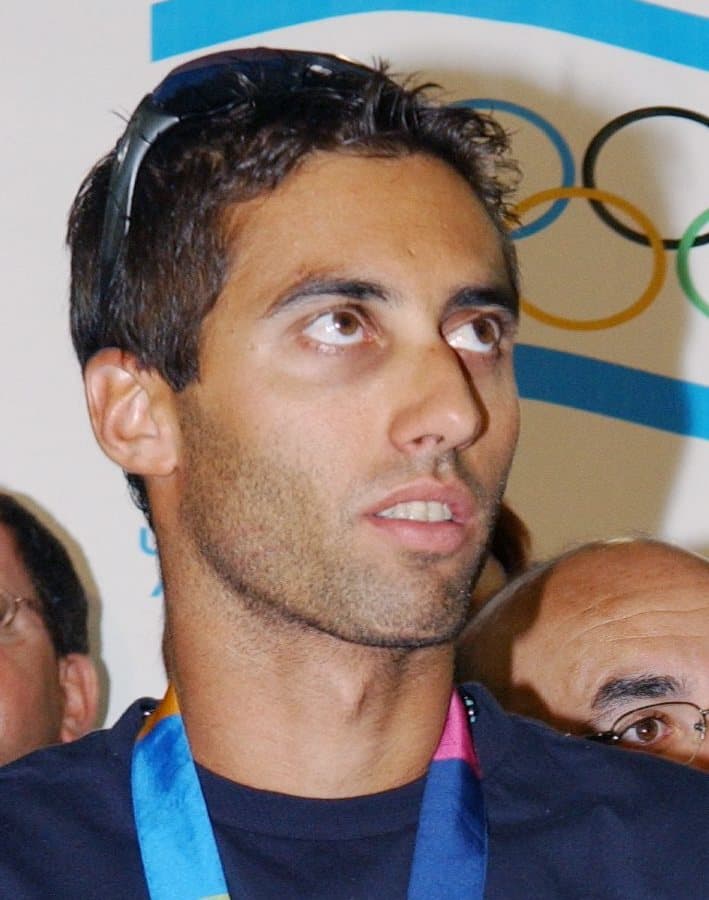
The wind off Wassaw Sound, in the tidal marshes east of Savannah, Georgia, was doing exactly what an Olympic windsurfing fleet dreads and craves in equal measure on the final day of racing: shifting, gusting, never quite settling. Forty-six sailors from forty-six countries had spent a week and a half racing one-design Mistral boards through the Atlanta Games' sailing regatta, and by 29 July 1996 the fleet had worked through nine of its eleven scheduled races before organizers called the series. Among the sailors fighting for the podium was a 20-year-old Israeli, barely known outside his sport, named Gal Fridman.
Four years earlier in Barcelona, Israel had finally broken its Olympic medal drought: Yael Arad's judo silver and Oren Smadja's judo bronze, both won within days of each other in 1992, were the country's first Olympic medals since it had entered the Games in 1952. It was a watershed moment, but it left an obvious question hanging over Israeli sport — could the country produce a medalist in anything other than judo? Atlanta was where that question got its answer, and the answer arrived on a sailboard.
Fridman was born on 16 September 1975 in Karkur and grew up sailing out of Sdot Yam, the kibbutz beside Caesarea whose nautical club has produced generation after generation of Israeli windsurfers. His father, Uri, put him on a board at the age of seven; by eleven he was racing. Windsurfing in Israel was, and largely remains, a Sdot Yam story — a small stretch of Mediterranean coastline that punches enormously above its weight in an Olympic class most countries treat as a niche.
The men's Mistral One Design fleet raced under the format standard to Olympic sailing at the time: eleven races on the schedule, each sailor's two worst results discarded, low net score wins. It rewards consistency as much as brilliance — a single disastrous race can be shrugged off, but a sailor has to be near the front, race after race, for a week and a half of shifting Georgia coastal wind. Fridman did exactly that.
When the series closed after the ninth race on 29 July, the podium read: gold to Nikolaos Kaklamanakis of Greece, the reigning world champion, with 17 net points; silver to Carlos Espinola of Argentina on 19; and bronze to Fridman on 21. New Zealand's Aaron McIntosh, the two-time reigning world champion of the class going into the Games, finished fourth on 27, agonizingly off the medals — a reminder of how unforgiving the discard system could be even to sailors with better overall pedigree than the podium finishers.
It was, in the end, the only medal Israel would win at the Atlanta Games. The Israeli delegation that summer numbered 25 athletes — 18 men and seven women — competing in 26 events across ten sports, with hurdler Lydia Hatuel-Zuckerman carrying the flag at the opening ceremony. None of them but Fridman came home with a medal. For a small team at a Games that many nations' larger federations treated as a numbers exercise, a single bronze from a 20-year-old windsurfer carried outsized weight.
It also carried historical weight. Fridman's bronze was Israel's third Olympic medal in its history, and its first ever won outside the judo hall. Where Arad and Smadja had shown Israel could win, Fridman showed it could win differently — that the country's sporting infrastructure, however modest, could turn out champions on the water as well as on the mat. He was named Israel's Sportsman of the Year for 1996, a 20-year-old suddenly carrying the label of trailblazer.
The story did not end at bronze. Fridman kept racing, kept improving, and in 2002 topped the International Sailing Federation's world rankings after winning the Mistral World Championship in Pattaya. Then, eight years almost to the month after Savannah, he returned to the same one-design windsurfing class at the Athens 2004 Olympics and won gold — becoming Israel's first Olympic champion in any sport, and, for years afterward, the only Israeli athlete to have won two separate Olympic medals.
The lineage he started at Sdot Yam did not stop with him, either. In 2008, a young windsurfer named Shahar Tzuberi — who had beaten Fridman himself for Israel's Beijing team selection — won bronze in the RS:X windsurfing class, Israel's only medal of those Games, echoing almost exactly what Fridman had done twelve years earlier: a lone medal, a lone windsurfer, carrying a small team's hopes across an ocean of wind and water.
None of it happens without that shifting Georgia wind on 29 July 1996, and a 20-year-old from a kibbutz windsurfing club who kept his board in the top three when it mattered most. Judo had opened the door for Israeli Olympic sport in Barcelona. In Savannah, Gal Fridman showed it could be walked through by almost anyone with enough wind at their back.